



About Contact Improvisation (CI)
2022 marked the 50th anniversary of the birth of Contact Improvisation. There were many celebratory gatherings around the globe. Check out our 'Workshop/Conference/Performance Projects' page for events we learned of. And the special 50th anniversary edition of the CI Newsletter is still preparing submissions for posting, aiming to complete by September 2025. Please stay tuned.
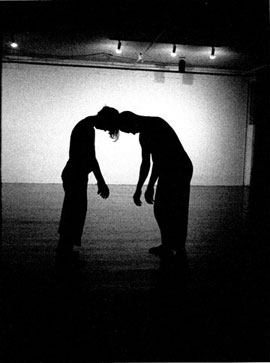
Head-to-head, [Left to right] Cathie Caraker and David Beadle. photo © Bill Arnold.
There are many ways of defining the dance form Contact Improvisation. Here are two:
Contact Improvisation is an evolving system of movement initiated in 1972 by American choreographer Steve Paxton. The improvised dance form is based on the communication between two moving bodies that are in physical contact and their combined relationship to the physical laws that govern their motion—gravity, momentum, inertia. The body, in order to open to these sensations, learns to release excess muscular tension and abandon a certain quality of willfulness to experience the natural flow of movement. Practice includes rolling, falling, being upside down, following a physical point of contact, supporting and giving weight to a partner.
Contact improvisations are spontaneous physical dialogues that range from stillness to highly energetic exchanges. Alertness is developed in order to work in an energetic state of physical disorientation, trusting in one's basic survival instincts. It is a free play with balance, self-correcting the wrong moves and reinforcing the right ones, bringing forth a physical/emotional truth about a shared moment of movement that leaves the participants informed, centered, and enlivened.
—early definition by Steve Paxton and others, 1970s,
from CQ Vol. 5:1, Fall 1979
Contact Improvisation is an open-ended exploration of the kinaesthetic possibilities of bodies moving through contact. Sometimes wild and athletic, sometimes quiet and meditative, it is a form open to all bodies and enquiring minds.
—from Ray Chung workshop announcement, London, 2009
Contact Improvisation (CI) was first presented as a series of performances conceived
and directed by American choreographer Steve Paxton in June 1972 at the John Weber
Gallery in New York City. Paxton invited about 17 students and colleagues to
participate in the two-week project. These dancers included Tim Butler, Laura Chapman,
Barbara Dilley, Leon Felder, Mary Fulkerson, Tom Hast, Daniel Lepkoff, Nita Little,
Alice Lusterman, Mark Peterson, Curt Siddall, Emily Siege, Nancy Stark Smith, Nancy Topf,
and David Woodberry. Several of them continue to practice the dance form today.
Videos of the initial performances, in narrated documentaries and edited concert footage from Videoda's CI Archive 1972-83, are now accessible to stream and download here on our website.
Steve Paxton, a dancer with a background in tumbling and martial arts, was a member of several modern dance companies in New York in the 1960s, including that of the revolutionary choreographer Merce Cunningham and his longtime collaborator, composer John Cage, a major innovator in musical and artistic thinking.
Paxton was a prime mover in the groundbreaking performances of the Judson Dance Theater in the mid-1960s in NYC, challenging assumptions about dance and opening up new possibilities for the art form, including what kinds of movement could be considered dance and how dances are made. Paxton's radical choreographic propositions in the sixties included his exploration of improvisation—both solo and in groups, most notably with the dance theater collective, Grand Union (1971–1976), which included Yvonne Rainer, Barbara Lloyd (Dilley), Nancy Lewis, David Gordon, Douglas Dunn, and Trisha Brown. It was during his time with the Grand Union that Paxton first proposed Contact Improvisation.
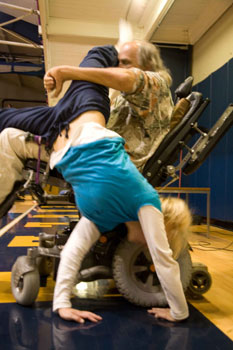
CI36 at Juniata College in Huntingdon, PA. photo: Paula Zacharias
From its early days on the East and then West coasts of the United States, Contact Improvisation (CI) has spread to studios, schools, and art centers around the world. Thousands of people practice, perform, and teach Contact on all continents except Antarctica.
CI is enjoyed by movers of all kinds—professionally trained dancers, recreational movers, athletes, dancers of all abilities and ages. Dancers apply their work with CI to choreography, to dance training, to working with children, seniors, mixed-ability populations, therapy, visual arts, music, education, environmental work, and social activism. Many do it just for pleasure and personal development.
Contact Improvisation's influence can be seen throughout modern and postmodern dance choreography, performance, and dance training worldwide, especially in relationship to partnering and use of weight.
Contact Improvisation celebrated its 36th birthday in June 2008 with a large gathering at Juniata College in central Pennsylvania. CI36 (co-hosted by Contact Quarterly dance journal and Juniata College) was linked to over a hundred "satellite events" celebrating Contact all over the world, including Australia, Argentina, Chile, Brazil, Japan, China, Russia, Siberia, and throughout Europe, the U.S., and Canada.
Contact Improvisation continues to develop and spread to new cities, countries, types of dancers, and areas of application. The work embraces those new to the form as well as those who have been devoted to its study and practice for decades.
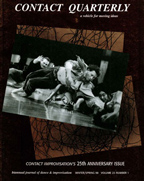
Contact Quarterly cover; Volume 23 No. 1, Winter/Spring 1998; CI's 25th Anniversary issue.
In 1975, the Contact Newsletter was started among the handful of dancers engaged in Contact Improvisation as a way to stay in touch with each other and the developments of the work. In 1976, the Newsletter became Contact Quarterly dance and improvisation journal, a vehicle for moving ideas, which for four and a half decades has tracked the developments of CI and related dance, movement, and somatic practices directly through the dancers' voice. The journal published its final biannual print issue in January 2020 and continues today online on CQ Unbound.
The CQ CI Newsletter, with news and views of Contact Improvisation activities worldwide, continued as a featured section in CQ print journal through Vol. 43. It moved online to increase public access in 2010. Its final issue as a biannual online publication was released in June 2020. At the onset of Covid lockdowns, in April 2020, views from the contact improvisation community continued to be voiced online on CQ's blog format Rolling Edition, which continued through September 2021. A special edition of the Newsletter was launched in 2022 to celebrate the 50th anniversary of Contact Improvisation. We are still preparing submissions for posting, aiming to complete by September 2025.
The bounty of materials about CI that CQ has generated over the years is available through its back issues and its Contact Improvisation Sourcebooks—collections of the significant writings about CI from the journal's inception in 1975 until 2018. The CI Sourcebooks and other books and DVDs about Contact and new dance are available through CQ's book project, Contact Editions. (For more publications on Contact, see Links to CI Resources.)
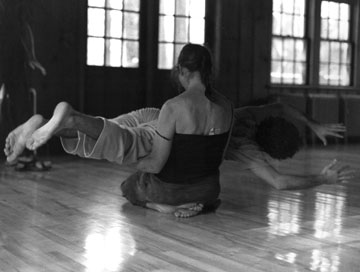
Breitenbush Jam, March 2006. photo: David Sommerville
Contact Improvisation classes, workshops, festivals, and "jams" are happening all over the world. These activities can be found through many CI websites, such as www.ciglobalcalendar.net, which contains a global listing of ongoing classes, jams, special events.
What is a Contact jam?
Contact Improvisation jams are leaderless practice environments in which dancers practice the dance form with whoever gathers—friends or strangers, old, young, experienced, novice. Some jams take place in a studio for a few hours once a week. Longer retreat jams might last several days, sometimes held in hot springs resorts or other retreat locations where dancers can practice at any hour of the day in the studio/lodge or take a rejuvenating soak or steam in the mineral waters. A few of these ongoing jams are:
(Selected text in About Contact Improvisation was adapted from Caught Falling, by David Koteen and Nancy Stark Smith.
There are an ever-increasing number of CI events, resources, and websites. Below are a few recommendations to get you started.
- ARTICLES:
- Harvest: One History of Contact Improvisation Harvest: One History of Contact Improvisation , a talk given by Nancy Stark Smith at the 2005 Freiburg Contact Festival, CQ Vol. 31 No. 2, Summer/Fall 2006
- Steve Paxton’s Talk at CI36 (excerpts) Steve Paxton’s Talk at CI36 (excerpts) , June 2008, CQ Vol. 34 No. 1, Winter/Spring 2009
- Contact Improvisation: A Question, by Daniel Lepkoff, April 2011, CQ Vol. 36 No. 1 Annual 2011
- MAGAZINES:
- Contact Quarterly, a vehicle for moving ideas, journal of dance and improvisation since 1975. Much material about CI as well as related dance and somatic work.
- Proximity. Australian magazine devoted to new dance/movement and improvisation practice. It has a focus on Contact Improvisation, movement improvisation, and other related forms.
- BOOKS:
- CQ's CI Sourcebook, Vol. 1: 1975–1992, Vol. 2: 1993–2007, and Vol.3: 2008-2018.
- Caught Falling: The Confluence of Contact Improvisation, Nancy Stark Smith, and Other Moving Ideas by David Koteen and Nancy Stark Smith with a Backwords by Steve Paxton.
- Contact Improvisation: An Introduction to a Vitalizing Dance Form by Cheryl Pallant.
- Contact Improvisation: Moving, Dancing, Interaction by Thomas Kaltenbrunner, (original German edition; English translation edition)
- Contact Improvisation and Body-Mind Centering: A Manual for Teaching and Learning Movement by Annie Brook
- Sharing the Dance: Contact Improvisation and American Culture by Cynthia J. Novack
- Taken by Surprise: A Dance Improvisation Reader edited by Ann Cooper Albright and David Gere
- Dancing Deeper Still by Martin Keogh
- VIDEOS:
- Historical documentaries and performances of CI (1972–1983), produced by Videoda.
- DanceAbility (CI & mixed-ability dance): www.danceability.com
- Touchdown Dance (CI for dancers with and without visual impairment): www.touchdowndance.co.uk
- Momentum, a commentaried video archive of CI: www.contactimprovisation.ch
- The Poetics of Touch: Nancy Stark Smith, a pathway into contact improvisation. A film by Sara Pozzoli and Germana Siciliani, with Italian subtitles:
- Some CI WEBSITES:
- Contact Quarterly dance and improvisation journal, site includes CI articles and writings, the online CQ CI Newsletter; and our store with digital books, back issues, and streaming videos.
- proximity.slightly.net Proximity magazine. Australian magazine devoted to new dance/movement and improvisation practice, including contact improvisation.
- www.ciglobalcalendar.net Global database of CI activities: free listing of ongoing classes, jams, teachers, organizations, and special events (retreat jams, festivals, conferences).
- www.contactimprovisation.ch European CI events, information, documentation, teachers, and links; free listings; in German.
- www.contactimprov.com Moti Mark Zemelman's CI site with paid event listings, CI teachers, jam map, gallery, store with Moti's CDs, photos, and other materials.
- www.ecite.org Information about past and present European CI Teachers Exchange (ECITE) events, with archive of materials.
- www.contactfestival.de Contact Festival Freiburg (Germany) website; with information on the upcoming festival, pre- and post-festival workshops, info about CI, an archive, photos, and links; in German and English.